
Ask Ross: Why are Exam Room Door Motors Mounted on the Fascia Side?
The motor for an exam room door is placed on the public side. Our architectural expert reveals the reasons behind this choice.
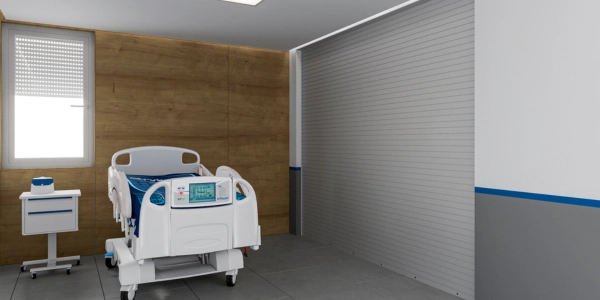
How do you determine the thermal performance of a commercial door? What effect does wind load have on the jambs and curtains? How are garage doors mounted? There are plenty of questions about commercial garage doors. In our Ask Ross series, we’re partnering with our Architectural Design Support (ADS) expert to answer your biggest questions about specifications, design, and performance.
When a healthcare facility needs to use one room for both general medical and behavioral health patients, an Exam Room Door is a clever, cost-effective solution. Unlike a typical rolling commercial door, where the motor is mounted on the coil side, or inside the barrel, the Exam Room Door motor is mounted above the ceiling on the public-facing, or fascia side of the door. This seemingly unusual design choice is pretty smart.
The Exam Room Door is engineered with a straightforward, hassle-free approach that simplifies maintenance, while its ligature, tamper, and impact-resistant features ensure patient security.
RELATED: Making Healthcare Furniture Safer with Anti-Ligature Spaces

Ross Baran is an architectural representative on the Clopay ADS team. With over seven years of experience, he helps architects and designers across the United States and Canada find the right commercial door solutions for their projects. He is a valuable resource for solving application issues and providing expert technical support.
Question: Why is the Exam Room Door’s Motor Mounted on the Fascia Side?
Answer: The motor is mounted on the fascia side for two primary reasons: maintenance and emergency access.
The application of the exam room shutter is to conceal closets that contain medical equipment, creating what's known as a "vault". This means the door is the only way to get in or out of that closet. If the motor were mounted on the inside (the closet side), and it failed or needed repair while the door was closed, there would be no way to access it.
By placing the motor on the fascia side, maintenance technicians can easily access it through a panel in the ceiling. This allows them to perform routine maintenance or conduct repairs without needing to get inside the locked closet. This placement also lets owners perform a manual override in an emergency, and building maintenance or authorized personnel can access the motor on the patient care side. Here, they can operate it with the auxiliary operation feature in case of a power loss.
Question: How Do You Access the Motor for Maintenance?
Answer: We recommend a 24” x 24” access panel in the ceiling on the patient care side. This gives technician’s ample room to reach the motor and perform any necessary work. This also allows for authorized personnel, or facility maintenance managers, to access the motor and manually operate it by means of the auxiliary operation feature if necessary.
Question: What Components are Concealed in the Wall and Ceiling?
Answer: The Exam Room Door offers both security and a sleek, streamlined appearance. Its components are concealed to create a seamless look. The guides and tube assembly are hidden within the wall construction, and the motor is enclosed above the ceiling on the patient-care side. The door coil and shaft is also concealed above the ceiling on the medical equipment side, ensuring the entire system is secure and out of sight.
Question: What are the Clearance Requirements for the Exam Room Door?
Answer: Headroom and sideroom clearance needs vary depending on the door's specific dimensions. It’s essential to have the correct amount of space for both proper installation and reliable operation. For project-specific requirements, it's best to contact our ADS team.
Looking for the perfect closure product for your next project? Our ADS team can help. Contact us for design phase product drawings and specification writing services.